
You have invested in good shampoos, conditioners, hair oils and perhaps expensive hair treatments. You eat reasonably well, take care of your hair and still find strands on your pillow, in your shower drain and on your hairbrush.
If this sounds familiar, it might be time to look beyond your scalp.
Your gut does much more than digest food. The microorganisms living in your digestive tract help break down dietary components, participate in nutrient metabolism, interact with your immune system and influence several processes throughout your body.
When gut function is disturbed, nutrient absorption, inflammation and metabolic processes can also be affected. These factors are relevant to hair growth because hair follicles require a continuous supply of nutrients and a healthy physiological environment.
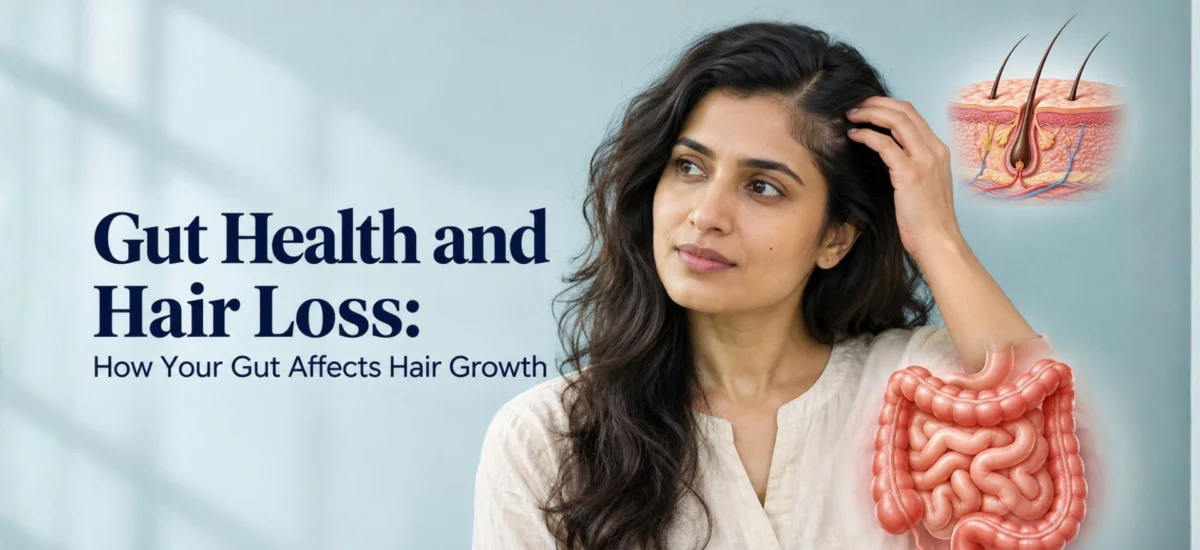
Researchers are increasingly investigating what is called the gut-hair axis: the possible relationship between the gut microbiome, immune regulation, metabolism and hair follicle health.
So, can poor gut health cause hair fall? What role do probiotics play? And could understanding your gut microbiome help you investigate persistent hair thinning?
Let's explore what science tells us.
Your gut contains trillions of microorganisms, including bacteria, fungi, viruses and archaea. Together, they form the gut microbiome.
These microorganisms interact with one another and with your body. They help digest certain components of food, produce metabolites such as short-chain fatty acids, participate in vitamin metabolism and communicate with the immune system.
The gut microbiome is therefore connected to much more than digestion.
The gut-hair axis describes the emerging relationship between gut microbial activity and hair follicle health.
There are four important areas through which this relationship is being investigated:
However, an important distinction is necessary. Research has identified associations between gut microbial changes and certain hair disorders, but this does not establish that gut dysbiosis causes hair loss in every individual.
The gut-hair axis is a promising area of research, not yet an established diagnostic or treatment pathway for hair loss.
Hair follicles are among the body's metabolically active structures. They need a continuous supply of energy, oxygen and nutrients to support the growth cycle.
Several processes connecting gut health and hair growth are worth understanding.
One of the most important connections between gut health and hair loss is nutrient availability.
Hair follicles require several nutrients for normal growth and maintenance. These include iron, zinc, vitamin B12, vitamin D, protein and other micronutrients.
The digestive system plays an essential role in making these nutrients available to the body.
Consider some examples.
Iron is required for haemoglobin production and oxygen transport. Iron deficiency, particularly when associated with low iron stores, is an important consideration in people experiencing diffuse hair shedding.
Women with heavy menstrual bleeding, inadequate dietary iron intake or gastrointestinal conditions affecting absorption may be particularly vulnerable.
Vegetarian sources include lentils, chickpeas, beans, sesame seeds, leafy vegetables and iron-fortified foods. Combining plant-based iron sources with vitamin C-rich foods can improve non-haem iron absorption.
Zinc participates in cell division, protein synthesis and tissue repair. These processes are important for normal hair follicle function.
Low zinc levels have been associated with certain forms of hair loss, although supplementation is not appropriate unless deficiency or another clinical indication is established.
Vitamin B12 is essential for DNA synthesis and normal red blood cell production.
People following vegetarian diets, particularly those who consume little or no dairy or fortified foods, can be at risk of inadequate B12 intake.
Certain gastrointestinal conditions can also interfere with B12 absorption.
Vitamin D participates in immune regulation and several processes involved in hair follicle cycling.
Low vitamin D levels have been associated with some hair disorders, although an association does not prove that supplementation will reverse hair loss in everyone.
Biotin is involved in several metabolic processes. Severe biotin deficiency can cause hair thinning, but it is uncommon in people eating a varied diet.
Taking high-dose biotin supplements without establishing a deficiency is not a reliable solution for hair fall. Biotin can also interfere with certain laboratory tests, including some thyroid and cardiac investigations.
Gut microorganisms participate in the metabolism of nutrients and produce compounds that influence intestinal physiology.
However, it is important not to assume that an altered microbiome automatically causes deficiencies of iron, zinc, B12 or biotin. Each nutrient has different absorption pathways, and several deficiencies have causes unrelated to gut bacteria.
Conditions such as coeliac disease, inflammatory bowel disease and other intestinal disorders can impair nutrient absorption and should be medically investigated when suspected.
This is why persistent hair fall accompanied by digestive problems deserves a broader evaluation.
Your intestinal lining is an important barrier between the contents of your digestive tract and the internal environment of your body.
It interacts continuously with food components, microorganisms and the immune system.
When intestinal inflammation develops, it can affect digestive function, nutrient absorption and immune signalling.
In conditions such as inflammatory bowel disease, persistent intestinal inflammation can be associated with nutritional deficiencies and hair shedding.
Inflammation can also occur outside the gut. For example, certain autoimmune and inflammatory conditions directly affect hair follicles.
This is where the gut-hair connection becomes particularly interesting.
Gut microorganisms produce metabolites, including short-chain fatty acids such as acetate, propionate and butyrate. These compounds participate in intestinal barrier function and immune regulation.
Butyrate, for example, is an important energy source for cells lining the colon and has been studied for its role in regulating inflammatory responses.
An altered microbial ecosystem could influence these processes, but the relationship between gut inflammation and hair thinning is still being investigated.
The important point is that persistent inflammation, wherever it originates, deserves attention rather than simply treating hair fall as a cosmetic concern.
Not all hair loss is caused by nutritional deficiencies or hormonal changes.
One example is alopecia areata, an autoimmune condition in which the immune system attacks hair follicles, producing characteristic patches of hair loss.
The gut microbiome interacts with the immune system and helps regulate immune responses. Researchers are investigating whether changes in gut microbial composition are associated with immune-mediated hair disorders.
A 2025 review published in JID Innovations examined changes in the gut and skin microbiomes in people with alopecia areata.
The research identified microbial differences associated with the condition, but the authors emphasised that a causal relationship has not yet been established.
This distinction matters.
It would be incorrect to claim that poor gut health causes alopecia areata or that restoring gut bacteria will cure it.
However, understanding how microbial communities interact with immune regulation may help researchers investigate additional factors involved in autoimmune conditions.
Hormones play a significant role in hair growth.
One common cause of hair thinning in women is androgen-related hair loss, which can be associated with increased sensitivity of hair follicles to androgens.
Women with polycystic ovary syndrome (PCOS/PCOD) may experience hormonal changes, including elevated androgen levels, that contribute to scalp hair thinning.
PCOS is also frequently associated with insulin resistance and metabolic disturbances.
The gut microbiome is being studied for its potential involvement in metabolic regulation, inflammation and the metabolism of certain hormones.
Gut microorganisms participate in processes involving bile acids and steroid hormone metabolism. The collection of microbial genes involved in oestrogen metabolism is sometimes described as the estrobolome.
These findings provide interesting insights into how the gut may interact with hormonal physiology.
However, gut dysbiosis has not been established as the cause of PCOS, and microbiome testing cannot diagnose hormonal disorders.
If you experience hair thinning alongside irregular periods, acne, unwanted facial hair or unexplained weight changes, consult a gynaecologist or endocrinologist for appropriate hormonal evaluation.
Addressing gut health can be part of a broader wellness approach, but it should not replace PCOS management.
Have you noticed increased hair shedding after an illness, a stressful period, surgery, significant weight loss or emotional trauma?
One possible explanation is telogen effluvium.
Normally, hair follicles move through different stages of growth, transition and rest. During telogen effluvium, a larger proportion of hair follicles enter the resting phase, leading to increased shedding.
This can become noticeable several weeks to a few months after the triggering event.
Stress can influence both gut function and the hair growth cycle.
The gut-brain axis is a communication network involving the nervous system, hormones, immune pathways and gut microorganisms.
Stress can influence intestinal motility, digestive secretions and gut microbial composition. At the same time, the gut microbiome produces metabolites that interact with several signalling pathways.
Cortisol and other stress-related signals are also being investigated for their effects on hair follicle cycling.
This does not mean that every episode of stress-related hair fall is caused by gut dysbiosis.
It does mean that sleep, stress management, adequate nutrition and digestive health deserve attention when addressing overall well-being.
Hair loss alone is not a reliable indicator of poor gut health. However, when hair thinning occurs alongside persistent digestive complaints, it may be worth investigating both.
Look for patterns such as:
These symptoms are not proof of gut dysbiosis or a connection with hair loss.
For example, fatigue and hair shedding can occur with iron deficiency, vitamin B12 deficiency or thyroid disorders. Digestive symptoms may have entirely separate causes.
If several symptoms occur together, a healthcare professional can help determine whether further investigations are needed.
You can also read our article on [10 Signs of an Unhealthy Gut] to understand the digestive and non-digestive signs that deserve attention.
Probiotics are live microorganisms that, when administered in adequate amounts, confer a health benefit on the host.
They are widely studied for their effects on digestive health, immune function and microbial balance.
But can probiotics help with hair growth?
The gut-hair axis has generated interest in the possibility that probiotics could influence hair health through immune regulation, microbial metabolites and inflammatory pathways.
A 2024 systematic review and meta-analysis published in Heliyon examined research on probiotics and hair growth.
The authors reported promising findings in some measures, including hair thickness, but the evidence was limited and included preclinical studies. The authors called for better human clinical trials.
Therefore, probiotics should not currently be considered an established treatment for hair loss.
Different probiotic strains have different properties.
A strain studied for diarrhoea, for example, cannot automatically be assumed to improve hair growth or reduce inflammation.
The effects of probiotics depend on:
This is why taking a random probiotic supplement simply because it contains many bacterial strains is not necessarily useful.
A more considered approach begins by understanding the individual.
Microbiome information can provide insights into the microbial community and its composition. Nutrition, symptoms, medications and health history also help determine whether a particular probiotic approach is appropriate.
At Microbiome Superhero, we believe probiotic selection should be guided by scientific evidence and individual requirements rather than a one-size-fits-all approach.
However, a microbiome report alone cannot establish which probiotic will improve hair growth. That specific benefit still requires stronger clinical evidence.
Read more about our [Personalised Probiotics] approach and our article on [Probiotics vs Prebiotics] to understand how these interventions differ.